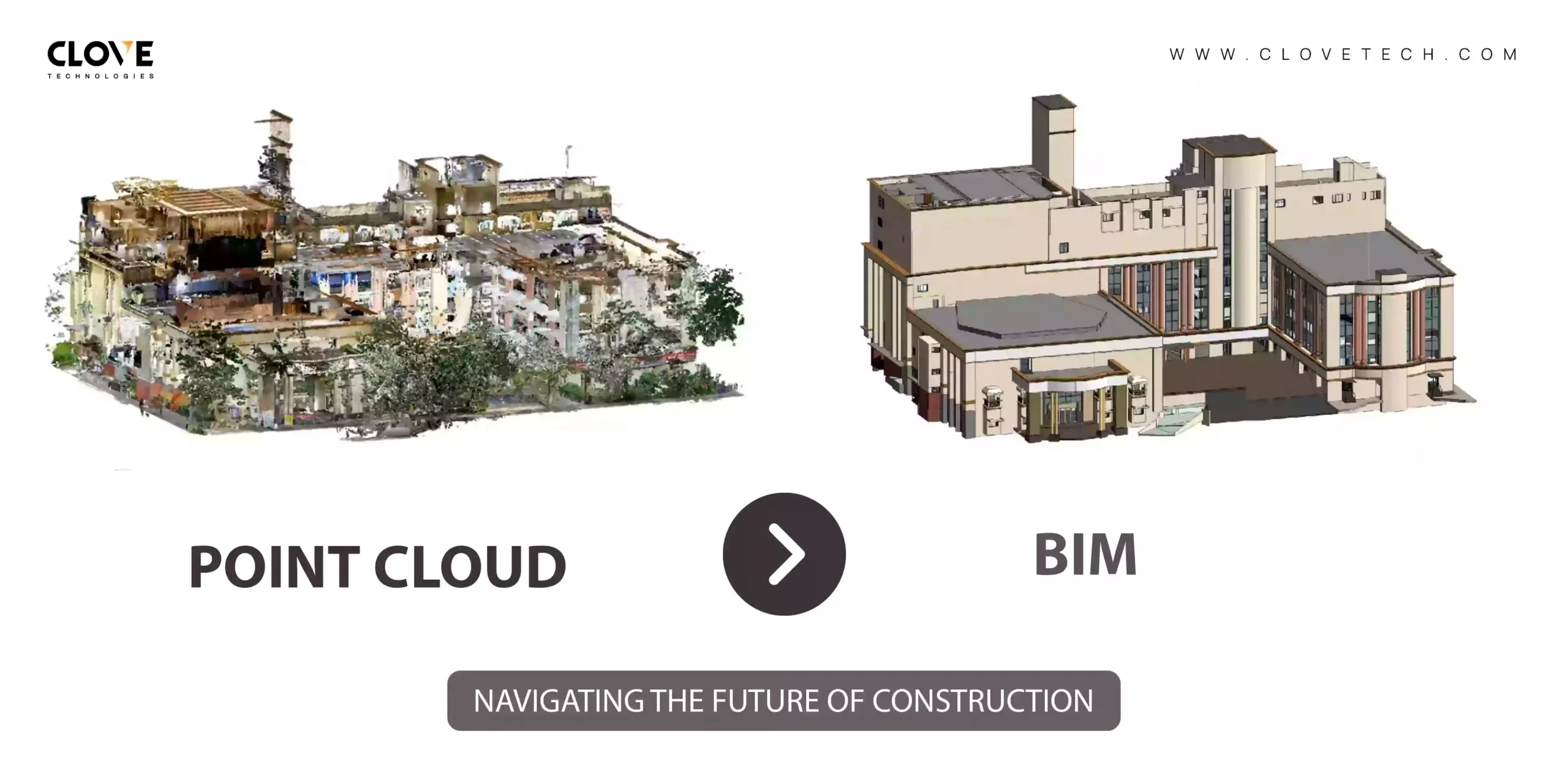
With ongoing advancements in the AEC industry, the digitalization of physical spaces into intelligent, data-driven models has emerged as a key requirement. Point cloud technology, generated through laser scanning or photogrammetry, enables highly accurate 3D capture of existing structures. When this data is translated into Building Information Modeling (BIM), it unlocks powerful opportunities for design, renovation, and facility management. This guide outlines the process, tools, and practical considerations involved in converting point clouds into Structured BIM Models.
Point cloud to BIM conversion refers to the process of transforming dense 3D scan data into an intelligent, structured digital model. While a point cloud represents millions of spatial data points capturing real-world geometry, a BIM model enhances this data by integrating geometry with meaningful information such as materials, systems, and specifications.
Often referred to as Scan to BIM, this workflow uses point cloud data as a reference framework within BIM software to reconstruct accurate 3D models. These models go beyond visualization, they provide actionable insights into architectural layouts, structural components, and MEP systems.
Data Acquisition
The process begins with capturing high-quality spatial data using 3D laser scanners or drones. A well-planned scanning strategy ensures minimal noise, complete coverage, and precise measurements of the environment.
Data Processing and Registration
Raw scan data is processed and aligned to create a unified point cloud. This step involves cleaning noise, correcting distortions, and ensuring accurate spatial positioning.
BIM Modeling
The processed point cloud is imported into BIM software, where skilled modelers reconstruct the geometry. Architectural, structural, and MEP components are developed in detail, ensuring the model aligns with project requirements and real-world conditions.
Quality Assurance
Accuracy checks are performed to verify that the BIM model matches the captured data. This ensures reliability for downstream applications such as construction planning or renovation.
Accuracy and Precision
Point cloud data captures real-world conditions with exceptional detail, enabling BIM models to reflect true dimensions. This reduces discrepancies and minimizes costly rework during construction.
Improved Collaboration
A centralized BIM model allows architects, engineers, and contractors to work with consistent and up-to-date information. This enhances coordination and reduces communication gaps across teams.
Better Decision-Making
With a detailed digital representation, stakeholders can evaluate multiple scenarios, optimize designs, and plan construction strategies more effectively.
As-Built Documentation
The final BIM model serves as a reliable as-built record of the structure. This is invaluable for maintenance, renovations, and long-term facility management.
Best Practices for Effective Conversion
- Ensure high-quality scanning with proper equipment and environmental conditions
- Use experienced BIM professionals for accurate modeling
- Maintain clear project requirements and Level of Detail (LOD) expectations
- Perform regular quality checks throughout the modeling process
- Choose the right BIM tools for efficient data handling and visualization
At Clove Technologieswe specialize in delivering precise and efficient point cloud to BIM solutions customized to meet specific project requirements. Our team focuses on converting raw scan data into intelligent BIM models that support better planning, reduced errors, and streamlined execution.
By leveraging advanced workflows and industry expertise, we help construction professionals enhance productivity, improve coordination, and make informed decisions throughout the project lifecycle.
As digital transformation continues to redefine the construction industry, integrating point cloud data with BIM is essential for modern project delivery. Converting real-world scans into structured digital models enables faster project delivery, improved accuracy, and reduced material waste.
Organizations that adopt this approach are better equipped to handle complex projects and adapt to modern construction demands with confidence.
Discover more of our innovative blogs

ISO 19650 Certified: Clove Technologies BIM Excellence
Factors That Influence BIM Service cost for Construction Projects

Transforming AEC with NavVis – Clovetech Experience as Early Adopters

How BIM Outsourcing can Transform your AEC Workflow
Let's Talk
Let’s discuss your requirements and see how our expertise can help on your next project.